
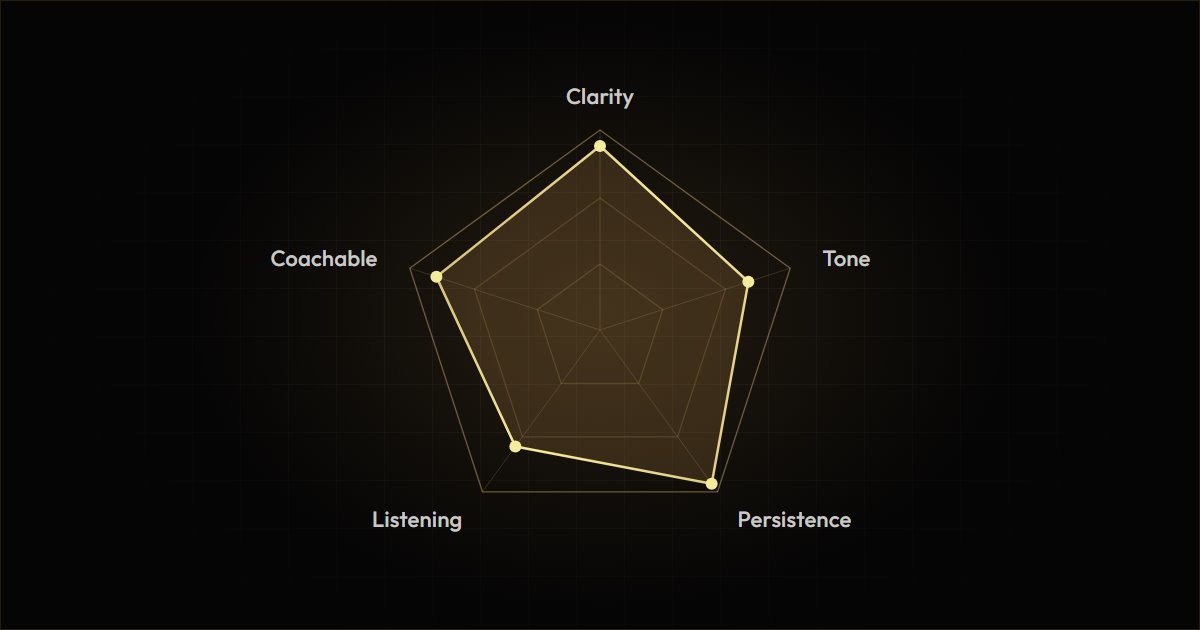
The instinct when hiring callers is to look for confidence and energy. It is the wrong filter, and it is why so many outbound teams have high turnover and inconsistent numbers. The best callers are rarely the most charismatic people in the room.
Consistency beats brilliance
Cold calling rewards the person who makes their dials on a bad day. Almost every caller has a good week; very few have a good quarter. A caller who does 150 dials every single day will beat one who does 250 on Monday and 60 on Thursday, because the second one is producing an unpredictable pipeline that cannot be planned around.
When you review a caller, look at the variance in their daily numbers before you look at the average. Flat is good. Spiky usually means something is wrong that nobody has mentioned yet.
Composure under rejection
A caller will be hung up on more times before lunch than most people are in a year. The trait that matters is not toughness but a genuine lack of interpretation. The ability to treat a hang-up as a data point rather than an event.
You can hear this in a call review. Callers who take rejection personally get faster and higher-pitched as the day goes on. Callers who do not sound the same at 4pm as at 12pm.
Curiosity, not persuasion
The single best predictor of a caller who produces qualified leads is whether they are actually interested in the answer. Callers who are trying to persuade talk more than the seller. Callers who are curious ask a question and then stop talking, which is much harder than it sounds and is where most of the useful information comes from.
In an interview, this shows up immediately: ask them about something and see whether they ask you anything back.
Clear speech, at the right speed
Accent matters far less than most people assume; pace and clarity matter enormously. A caller with a noticeable accent who speaks clearly and slightly slowly will be understood and trusted. A caller with no accent who rushes will be asked to repeat themselves and will lose calls in the first ten seconds.
This is coachable, and it is the highest-return coaching available. Most new callers speak too fast because they are nervous, and almost all of them improve within a fortnight of being told.
Honesty in dispositioning
Underrated and expensive when absent. A caller who marks marginal conversations as interested to keep their appointment count up creates a pipeline that looks healthy and converts at nothing, and it takes weeks to trace back. Callers who mark honestly, including marking their own good-sounding calls as weak, are worth more than their raw numbers suggest.
What does not predict performance
- Prior sales experience, often a negative, because closing habits transfer badly to qualifying
- Extroversion: the best callers are frequently quiet people who listen well
- Enthusiasm in the interview: interviews reward performance, and calling rewards endurance
- Speed of speech, usually the opposite of what you want
How to test for it in an hour
Do not rely on the interview. Give a short live exercise: a script they have had for ten minutes, a handful of real numbers, and listen. You are not judging whether they are good yet. You are listening for whether they ask questions, whether they recover after a hang-up, and whether their pace holds.
Then look at what they wrote down afterwards. A caller who took notes a stranger could act on is showing you the trait that matters most and is hardest to train.
Elite Reach Solutions hires and trains against these traits directly, and reviews recorded calls against the client script so performance is a matter of evidence rather than impression.