
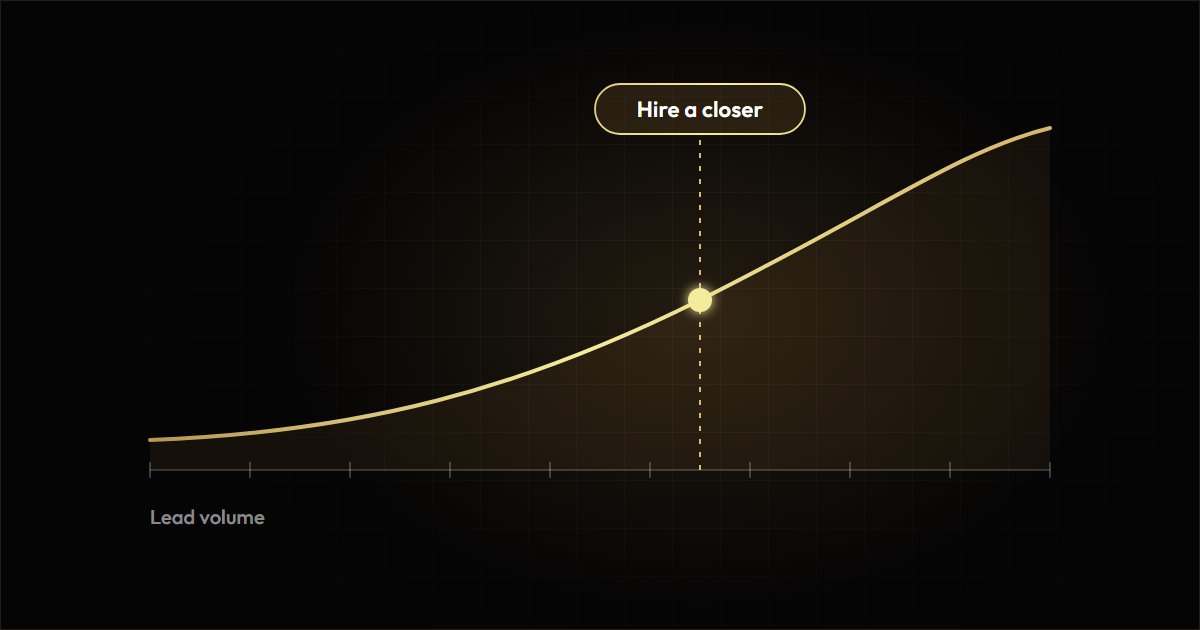
Hiring a closer is one of the few decisions in this business with a clear right time, and it is knowable from numbers you already have. Most operations get it wrong in both directions, some hire far too early on the theory that a salesperson will create deals, others hold on for months while qualified leads go cold.
The signal that says now
One number: how long a qualified lead waits before somebody has a real conversation with it. If that time is measured in hours, you are fine. If it is consistently more than a day and growing week on week, closing has become the constraint and every additional caller is making the problem worse rather than better.
This matters because lead value decays fast. A seller who agreed to a callback and hears nothing for four days has usually spoken to somebody else, or has stopped thinking about it. Delay does not postpone the deal, it destroys a proportion of it.
Other signals worth watching
- Follow-up is not happening: leads that said no once are never contacted again, which is where a large share of contracts live
- The investor is taking calls at unpredictable hours because there is no one else
- Leads are being marked dead with no reason recorded, usually meaning nobody had time to work them
- Cold calling volume drops in weeks when lead flow is good, which is the combined-role oscillation
Why hiring too early is worse
An underfed closer is expensive in a way that compounds. They have time on their hands, so they work each lead too hard, push sellers who were not ready, and burn leads that patient follow-up would have converted. They also become demoralised quickly, because their compensation is tied to something the business is not supplying.
The instinct that a closer will "create their own pipeline" is almost always wrong in real estate acquisitions. Closers convert opportunity; they do not manufacture it. If lead flow is the problem, a closer will not fix it and will make the cost per deal worse while you find that out.
Fix the lead supply first
Before hiring a closer, be honest about whether the queue is real:
- Count genuinely qualified leads per week, with condition, timeline, motivation and price expectation actually recorded
- Count how many were contacted within 24 hours
- Count how many were followed up more than once
- If the second and third numbers are low but the first is also low, you have a calling problem wearing a closing problem costume
A lot of operations that believe they need a closer actually need better dispositioning, because the qualified lead count is inflated by callers marking weak conversations as interested.
When the investor should hand it over
The investor is usually the best closer in the business at the start, and the worst use of time later. The transition point is when closing has become repeatable enough to describe, when you can write down the buy box, the offer logic and the follow-up cadence.
If you cannot write those down, a new closer has nothing to learn from and will invent their own, which is how offers start going out that you would not have made.
What to hire
Look for patience and arithmetic rather than sales energy. The best closers in this business are usually calm, comfortable with silence, and genuinely interested in the property. Someone who wants to pitch will push sellers away.
Test with a real lead and a real repair estimate: ask them to walk you through how they would arrive at a number and how they would present it. You will learn more in fifteen minutes than in an hour of discussion about their track record.